The only way to simplify football is to make it complicated. As such, understanding who Brian Clough was and his impact on football seems appropriate for a man who embodied swagger, coolness, class, genius, insanity, arrogance, and brilliance; a man who whittled himself into one of the game’s sharpest thinkers with a winner’s edge. The great leaders in football master the ability to teeter that fine line between genius and madness, and Brian Clough took genius and madness to another level. ‘Cloughie’ was always ‘on the verge’.
Perhaps the best place to start Cloughie’s story is Huddersfield, where Dave Mackay, the truly great Dave Mackay put his foot on the ball under the most intense pressure inside his own six-yard box and calmly and deliberately played Derby out of trouble with ONE pass changing defence into attack. Peter Taylor whipped around, looked at Brian with a glint in his eye. A glint of bottled excitement. A glint of acknowledgement that Derby were on their way. Clough and Taylor had inherited this lot, 3 years back at the foot of the second division. Three years later they were up there challenging Revie’s Leeds and Busby’s United. Not only challenging them in terms of results but also natural flair and charisma – the hallmark of every Clough team.
The marriage didn’t last. Boardroom politics coupled with his television antics and regular fines led to Clough handing in his resignation, a week after beating Manchester United 1-0 at Old Trafford and by then, sitting second in the table. It was accepted but not without a fair bit of drama. Then Leeds happened but I’ll leave that for another cup of brew, another evening.
Great football managers see the game differently. Clough saw the game in ways that channelled his stubborn, oftentimes angry, brilliance, which manifested in unprecedented heights of domestic and European success. From the outside looking in, it’s clear that when Clough, like all great managers, felt conflicted about something it’s because he was succeeding against the odds, with less resources and talent at his disposal and because he was seeing football from the necessary angles. Brian Clough showed that there are no aha! moments without delving deep into the complex.
To put that into context, the best case would be to imagine Queens Park Rangers, 13th in the Championship last season, winning promotion next May, then the Premier League at the first attempt, back-to-back Champions Leagues, a couple of Capital One Cups and creating a record for going unbeaten in the top division – 42 matches in Clough’s case – that would last a quarter of a century.
Forest were that team: 13th in the old Division Two when Clough landed his coat on the peg for the first time, on 6 January 1975. They did all the above within five years, as well as knocking Liverpool, the double European Cup winners, off their perch, long before Sir Alex Ferguson coined the phrase. They did it with five players – Anderson, Martin O’Neill, Ian Bowyer, Tony Woodcock and John Robertson – who were there from the start and the journey took them from five points off the relegation places into Division Three, with sub-8,000 gates, to Camp Nou, taking on Barcelona for the Super Cup. Another trophy was added to the collection and when they left the stadium that night there was a mob waiting outside. “Two rows of Barcelona fans, eight deep, all the way from the exit to our coach,” John McGovern, the captain, recalls. “They were all very quiet and I thought: ‘We could be in trouble here.’ It was then they started clapping. As we walked to our coach they clapped us all the way. Not a Forest fan in sight, all Barcelona fans. Clapping us out of their own stadium.”
The story will never happen again but, equally, it had never happened before either. People forget that Forest went up with 52 points, the fifth-lowest of any promoted team in history, and that they lost to York, Peterborough and, twice, Bristol Rovers before Peter Taylor joined Clough’s side and everything suddenly clicked with a team described in one newspaper as “a mix of fresh and well-worn faces who ought to be slogging it out at the bottom of the table”.
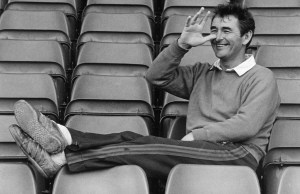
A line that most comes to mind is ‘you either die a hero, or you live long enough to see yourself become the villain.’ Cloughie went for the latter. It’s no secret that he had a drinking problem. Most great men do. He didn’t smile as much when Peter left. The empire he had built from scratch, from the dark deeps of the third division, straight on to retaining the European Cup whilst maintaining and upholding the aesthetics and the beauty with which the sport is ought to be played, collapsed slowly in front of him and ended in relegation at the City Ground.
During his last match in charge, Clough stood straight-backed outside the dugout like a captain determined to be on the deck when the ship went down. After the final whistle, when the crowd poured onto the pitch, in one clip, Clough can be seen accepting a flower from a little girl as distraught as a mourner at a funeral. He looked at her, his head on one side and said tenderly, ‘Hey beauty, no tears today, please.’
‘Can I have a word from you, Brian,’ asked a television interviewer outside the ground. ‘Of course,’ said Clough, walking away. ‘Goodbye.’
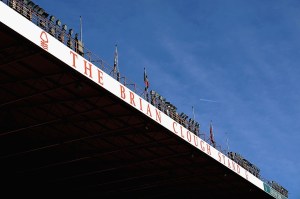
A man’s life has to be judged in the full and Clough’s legacy should not just be measured by his European Cups and all the other trophies. It was the charisma with which he did it, with his own set of rules, and the way he mesmerised everyone in his company, to the point that Clough in his pomp could probably have sauntered up to the gates of the White House and persuaded whoever was on the door to let him in.
If you missed those years you should dig out the clip of him verbally jousting with Muhammad Ali on that 1973 episode of The Big Match and wonder how many football managers would have the wit and presence to bring the greatest of them all to declare: “Clough, I’ve had enough!”
Search for that famous interview with John Motson when Clough, straight off the squash court, provides nine minutes of television gold, much of it at the expense of the man sitting opposite him. Or the footage of the Calendar Special on the night he was fired at Leeds United and his boyish joy when he realises he has got under the skin of Don Revie, doing his absolute best to avoid eye contact in the next seat. Clough, leaning in, even gets in a brilliantly condescending “good lad”.
In that very interview, Clough described himself perfectly: “That might be aiming for utopia. And that might mean being a little bit stupid. But that is the way I am. I am a little bit stupid regarding this type of thing. I am a bit of an idealist. I do believe in fairies. And that is my outlook.”
Brian Clough was polarizing in ways that make today’s most outspoken football managers look like choir boy conformists. With a comic’s wit and a watchmaker’s ability to grind gears and make time tick at his pace, his biggest asset was his ability to play the roles of footballer, manager, critic, comic, husband, father, psychologist, hero, and villain. As much as the man from Middlesbrough is considered a football man, perhaps it is best to simply consider Brian Clough as football itself.
And in conclusion, I’m not sure if this is the best piece I’ve put together but it’s in the top one.
 Into Added Time